If you’ve been researching options for muscle tension or general wellness support, you’ve likely come across two terms that sound almost identical: acupuncture and dry needling. Both use thin, sterile needles inserted into the skin, and at a glance, the tools look the same. Search results often list them side by side as if they’re interchangeable, which only adds to the confusion. But the philosophy, training, and approach behind each practice are genuinely different, and that difference matters more than most comparison articles let on.
At Central Park Naturopathic, patients often ask which one is “better” or which one they should request for an upcoming appointment. The honest answer is that they aren’t competing versions of the same thing. They come from different traditions, were developed for different purposes, and are practiced by people with different training backgrounds. Understanding that difference is the first step in having an informed conversation with your provider, rather than guessing based on a search engine result.
Where Each Practice Comes From
Acupuncture is rooted in Traditional Chinese Medicine (TCM), a system of practice that has been developed and refined over thousands of years. In this framework, needles are placed at specific points along the body that practitioners refer to as meridians. The philosophy is holistic, meaning a practitioner typically considers a patient’s overall constitution, energy flow, sleep, digestion, and general wellness picture, not just a single point of discomfort, when planning a session. The theory behind point selection is internally consistent and has its own diagnostic language, separate from Western anatomical terms.
Dry needling, by contrast, is a modern technique that grew out of Western physical medicine in the mid-20th century. It borrows the needle as a tool but applies it through an entirely different lens, one grounded in neuroanatomy and musculoskeletal science rather than TCM theory. Practitioners who perform dry needling are typically trained to locate specific muscular trigger points using anatomical landmarks, palpation, and knowledge of muscle structure rather than meridian maps. It was designed as a targeted, narrow-scope tool rather than a full system of medicine.
So while the instrument overlaps, the reasoning behind where and why a needle goes in a particular spot is fundamentally different between the two approaches, and that reasoning shapes almost everything else about how a session unfolds.
Training and Who Performs Each Technique
This is one of the most practical differences for patients to understand, and it’s often the one that gets overlooked. Licensed acupuncturists typically complete a multi-year accredited program specifically focused on TCM theory, diagnosis, point selection, and needling technique, along with supervised clinical hours before they’re eligible for certification or licensure. It is a distinct, standalone discipline with its own regulatory body in most provinces and states.
Dry needling, on the other hand, is usually offered as an additional skill layered onto another primary credential, most often physiotherapy, chiropractic, or in some cases naturopathic medicine. A practitioner typically completes a separate, shorter certification course in dry needling technique after they are already licensed in their base profession. This is sometimes referred to by names like intramuscular stimulation (IMS), which is a related but not identical trigger-point approach with its own training lineage.
Because of this, the person holding the needle may have very different foundational training depending on which service you book, even if both are described using needle-based language on a clinic’s website. Asking a provider directly about their certifications is always a reasonable question, and a good clinic will answer it plainly.
The Needles Themselves
Patients sometimes ask about needle size when comparing dry needling vs acupuncture, and the honest answer is that the needles used in both practices are extremely similar in most cases. Both typically use thin, solid filiform needles, quite different from the hollow needles used for injections or blood draws. Some dry needling techniques may use a slightly different gauge or length depending on the depth of the target tissue, but visually and physically, the tools themselves are often nearly indistinguishable to the naked eye.
The real distinction is not in the needle. It’s in the placement strategy, the underlying theory guiding that placement, and how many needles are typically used in a single session. Acupuncture sessions often involve a broader distribution of needle points across the body, while dry needling tends to concentrate on one or two specific muscle regions.
What a Session Might Look Like
A typical acupuncture session at a clinic like ours often begins with a broader intake conversation. Your practitioner may ask about sleep, stress levels, and general wellness patterns before determining a treatment plan for that particular visit. Needles are usually left in place for a period of time, often 20 to 40 minutes, while you rest in a quiet room.
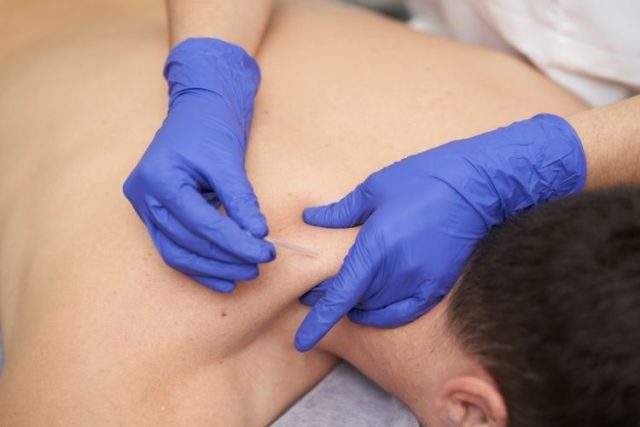
A dry needling session tends to be more narrowly focused on a specific muscle or muscle group. The practitioner typically locates a trigger point through palpation, inserts the needle, and may manipulate it briefly to elicit a local muscle response before removing it. Sessions are often shorter overall, and needles are usually not left in place for extended rest periods the way they frequently are in acupuncture.
Neither approach is inherently more or less involved than the other. They’re simply built around different clinical goals and different session structures.
How to Decide Which to Ask About
Because the two techniques stem from different training backgrounds and philosophies, the right starting point isn’t to search for which one sounds more effective online. It’s to have a direct conversation with your provider about your specific situation, your history, and what each approach actually involves for you personally.
If you’re a patient in the Burnaby area weighing acupuncture vs dry needling, the team at Central Park Naturopathic can walk you through what each session typically involves, how each practitioner is trained, and what a first visit looks like, so you can make a decision that’s grounded in accurate information rather than marketing language. Every patient’s circumstances are different, and a conversation with a licensed practitioner will always give you a clearer picture than a general comparison article.
A Note on Doing Your Own Research
If you want to read more before your appointment, reputable starting points include the National Center for Complementary and Integrative Health, which publishes plain-language overviews of acupuncture as a practice, and professional physical therapy associations that publish position statements on dry needling training standards. These sources can help you understand the frameworks each technique is built on before you sit down with a provider and ask your own questions.
Final Thoughts
Acupuncture and dry needling share a tool but not a tradition. One is a centuries-old system built on TCM theory and licensed as its own discipline. The other is a modern, targeted technique usually layered onto an existing clinical credential. Knowing this difference won’t tell you which one is right for you on its own, but it will make your conversation with a provider a lot more productive and a lot more informed.
If you have questions about either approach, reach out to Central Park Naturopathic in Burnaby to book a conversation with a licensed provider who can walk you through your options directly.